The History of Sigiriya
The story of Sigiriya is not just a tale of architectural genius; it is a violent, Shakespearean drama of royal succession, patricide, and a king driven by fear and artistic obsession to build a fortress in the clouds.
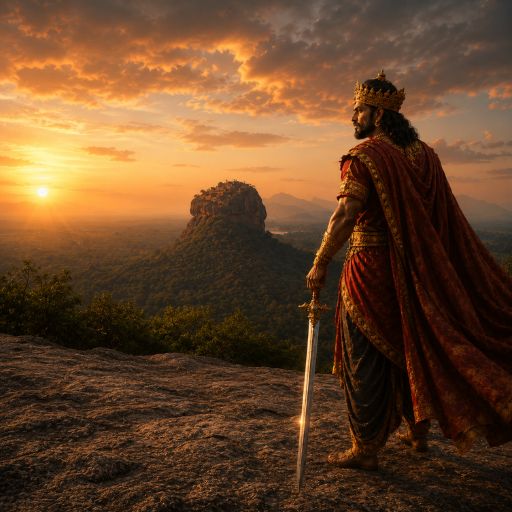
King Kasyapa's Ascent (477 - 495 CE)
In 477 CE, Kasyapa, the king's son by a non-royal consort, seized the throne from King Dhatusena. With the assistance of Migara, the king's nephew and army commander, Kasyapa orchestrated a coup that ended in the brutal execution of his father. The rightful heir, Kasyapa's half-brother Moggallana, fled to Southern India out of fear for his life.
Knowing that Moggallana would eventually return to claim the throne, Kasyapa moved the capital from the traditional seat of Anuradhapura to the more secure and dramatic location of Sigiriya. Over his reign, he transformed the sheer granite monolith into an impenetrable fortress and a hedonistic royal pleasure palace.
Despite the massive fortifications, when Moggallana finally returned with an army in 495 CE, a tactical error caused Kasyapa's troops to misinterpret his maneuvers as a retreat. Abandoned by his army, Kasyapa fell on his own sword, ending his reign and returning the capital to Anuradhapura.
Historical Timeline
3rd Century BCE
The Aligala rock shelter at the base of the rock is used by Buddhist monks as a monastery.
477 CE
Kasyapa seizes the throne. Moggallana flees to India. Sigiriya is chosen as the new capital.
477 - 495 CE
The massive construction phase. The water gardens, mirror wall, frescoes, and summit palace are constructed.
495 CE
Moggallana defeats Kasyapa. The site is handed back to Buddhist monks and serves as an outpost.
1831
Major Jonathan Forbes of the 78th Highlanders discovers the bush-covered summit of Sigiriya.
1982
Sigiriya is designated a UNESCO World Heritage Site due to its immense cultural and architectural significance.
UNESCO World Heritage Site
Sigiriya is considered one of the most important urban planning sites of the first millennium. The site plan is incredibly elaborate and imaginative, combining concepts of symmetry and asymmetry to intentionally interlock the man-made geometrical and natural forms of the surroundings. It remains one of the best-preserved examples of ancient urban planning in the world.